
Starting a business does not always require a large amount of money. With the right idea, basic skills, and a willingness to learn, you can start a small business with limited capital and gradually grow it over time. Today, many entrepreneurs are choosing flexible businesses that can be operated from home or online.
If you are looking for business ideas with low investment, there are many options worth considering. From freelancing and online tutoring to social media management and home-based services, you can choose a business based on your skills, interests, and available budget.
In this guide, we will explore practical low-investment business ideas and explain how you can get started.
Why Start a Low-Investment Business?
A low-investment business can be a good option for beginners because it reduces the amount of money you need to risk at the beginning. Instead of spending thousands of dollars on an office, equipment, and inventory, you can start small and reinvest your profits.
Another advantage is flexibility. Many low-cost businesses can be operated from home, which means you may not need to pay commercial rent. Online businesses can also allow you to work with customers from different locations.
The most important thing is to choose a business that matches your skills and has a clear demand in the market.
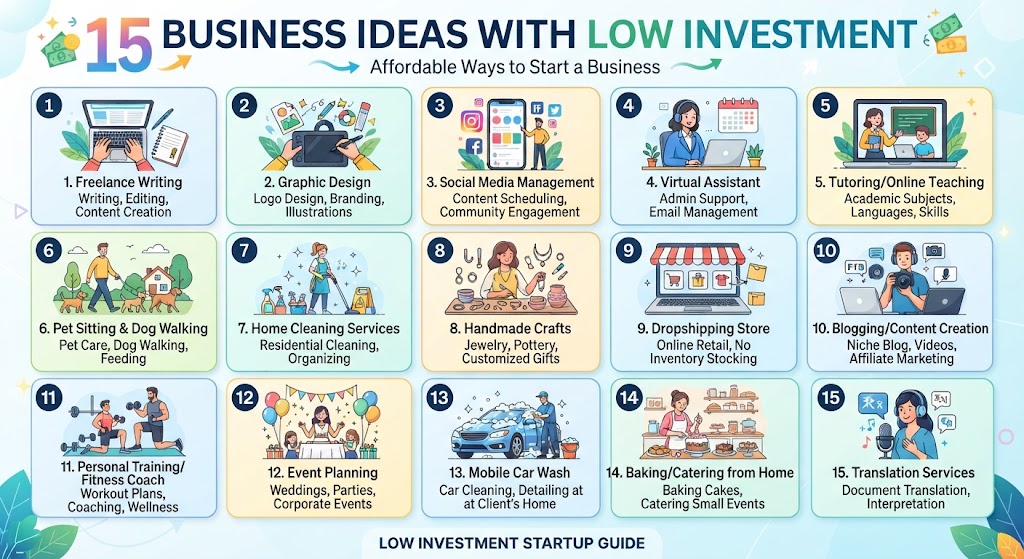
15 Business Ideas With Low Investment
1. Freelance Writing
If you have strong writing skills, freelance writing can be an affordable business to start. Businesses constantly need blog posts, website content, product descriptions, newsletters, and social media posts.
You can start with a computer and an internet connection. Create a simple portfolio with a few writing samples and offer your services through freelance platforms, social media, or direct outreach.
As your experience grows, you can specialize in areas such as technology, finance, travel, health, or business.
2. Social Media Management
Many small businesses want to maintain an active presence on platforms such as Instagram, Facebook, TikTok, and LinkedIn but do not have enough time to manage their accounts.
A social media management business can provide services such as content scheduling, caption writing, basic graphic design, community management, and social media strategy.
You can start with free or inexpensive design and scheduling tools. Finding a few local clients can help you build a portfolio and generate recurring monthly income.
3. Online Tutoring
Online tutoring is another business that can be started with relatively little investment. If you are knowledgeable about a subject, you can teach students online.
Popular subjects include English, mathematics, science, computer skills, business, and foreign languages. You can offer one-on-one classes through video calls or create group sessions.
A computer, internet connection, webcam, and a quiet place to teach may be enough to get started.
4. Virtual Assistant Services
Virtual assistants help businesses and entrepreneurs with everyday administrative tasks. These tasks may include managing emails, scheduling appointments, preparing documents, researching information, and updating spreadsheets.
This is one of the attractive business ideas with low investment because you can start from home with basic computer skills.
As you gain experience, you can specialize in areas such as real estate assistance, e-commerce support, customer service, or executive assistance.
5. Graphic Design
If you have a creative side, graphic design can become a profitable service business. Small businesses need designs for logos, social media posts, advertisements, brochures, presentations, and websites.
You can start by creating sample designs for your portfolio. Free and affordable design software can help beginners practice without making a major investment.
Over time, you can build a recognizable brand and charge higher rates for specialized design services.
6. Website Design
Businesses need websites to establish credibility and attract customers. This creates opportunities for people who know how to build websites using platforms such as WordPress.
You do not necessarily need to become an advanced programmer. You can start by learning basic website design, page layouts, responsive design, and website management.
Once you have several projects in your portfolio, you can target small businesses, freelancers, restaurants, local service providers, and online stores.
7. Affiliate Marketing
Affiliate marketing allows you to earn commissions by promoting products or services from other companies.
You can create a website, blog, YouTube channel, Pinterest account, or social media page around a specific topic. When someone purchases a product through your affiliate link, you may receive a commission.
This model usually requires more time than money. The biggest challenge is building an audience and creating useful content that attracts people through search engines and social media.
8. Print-on-Demand Business
Print-on-demand allows you to sell customized products without keeping large amounts of inventory. Products can include T-shirts, mugs, posters, phone cases, and other items.
When a customer places an order, the product is printed and shipped by a third-party provider.
Your main responsibilities are creating designs, marketing your products, and managing your online store. This can make print-on-demand an appealing option for creative entrepreneurs.
9. Digital Products
Selling digital products is another low-cost business model. Unlike physical products, digital products can often be created once and sold repeatedly.
Examples include templates, checklists, ebooks, spreadsheets, planners, educational resources, and design files.
The key is to create something that solves a specific problem. For example, a small business owner might purchase a social media content calendar because it saves time.
10. Home Cleaning Service
Not every low-investment business needs to be online. A home cleaning service can be started locally with basic cleaning supplies and transportation.
You can begin by serving homes in your local area and build your reputation through referrals and positive reviews.
As demand increases, you can hire additional cleaners and turn a small operation into a larger local service business.
11. Pet Care Services
Pet owners often need reliable people to walk, feed, or look after their pets while they are working or traveling.
A pet care business can include dog walking, pet sitting, grooming coordination, or overnight care.
Startup costs can be relatively low, especially if you begin by serving customers in your neighborhood.
12. Photography Services
If you already own a good camera and enjoy photography, you can turn your skill into a service business.
You can specialize in portraits, product photography, small business content, real estate photography, or events.
You can initially focus on building a portfolio rather than purchasing expensive equipment. Once you start earning, you can reinvest in better cameras, lighting, lenses, and editing software.
13. Reselling Products Online
Online reselling involves purchasing products at a low price and selling them at a higher price. Products can be sourced from clearance sales, wholesalers, local suppliers, or secondhand markets.
You can sell through an online marketplace or your own website.
The key to success is understanding product demand, calculating all costs, and choosing products with enough profit margin.
14. Consulting
If you have professional experience in a particular field, consulting can be an excellent low-investment business.
For example, someone with experience in marketing could offer marketing consulting, while an experienced accountant could provide financial guidance to small businesses.
Because consulting is based primarily on expertise, startup costs can be much lower than businesses that require physical inventory or equipment.
15. Local Digital Marketing Service
Small businesses often struggle to attract customers online. You can help them improve their online presence through services such as local SEO, content creation, social media management, Google Business Profile optimization, and online advertising.
Start with one or two services instead of trying to offer everything. Once you develop results and testimonials, you can expand your service packages.
How to Choose the Right Low-Investment Business
Choosing from many business ideas with low investment can be difficult. Start by identifying your strongest skills. Ask yourself what you can already do well and what people are willing to pay for.
Next, consider the demand in your target market. A great business idea is not useful if there are no customers.
You should also calculate your startup expenses. Include software, equipment, marketing, transportation, website costs, and other necessary expenses.
Finally, start small. You do not need to build a large company immediately. Your first goal should be to get your first few customers, understand their needs, and improve your service.
How to Start a Business With a Small Budget
Starting small does not mean starting without a plan. Begin by choosing one specific service or product. Research your competitors and identify what makes your offer different.
Create a simple business name, basic branding, and online presence. You can use social media to showcase your work and connect with potential customers.
Focus on getting your first customers rather than spending heavily on advertising. Personal networking, referrals, direct outreach, and useful content can help you attract customers without a large marketing budget.
Once you start making money, reinvest a portion of your profits into better tools, marketing, education, and customer service.
Final Thoughts
There are plenty of business ideas with low investment for people who want to become entrepreneurs without taking on significant financial risk. Freelancing, tutoring, virtual assistance, social media management, website design, digital products, local services, and consulting are just some of the options available.
The best business is not necessarily the one that requires the least money. It is the one that matches your skills, solves a real customer problem, and has room to grow.
Start with what you know, keep your expenses under control, focus on providing genuine value, and reinvest your early profits. With consistency and patience, a small business can become a sustainable source of income.