
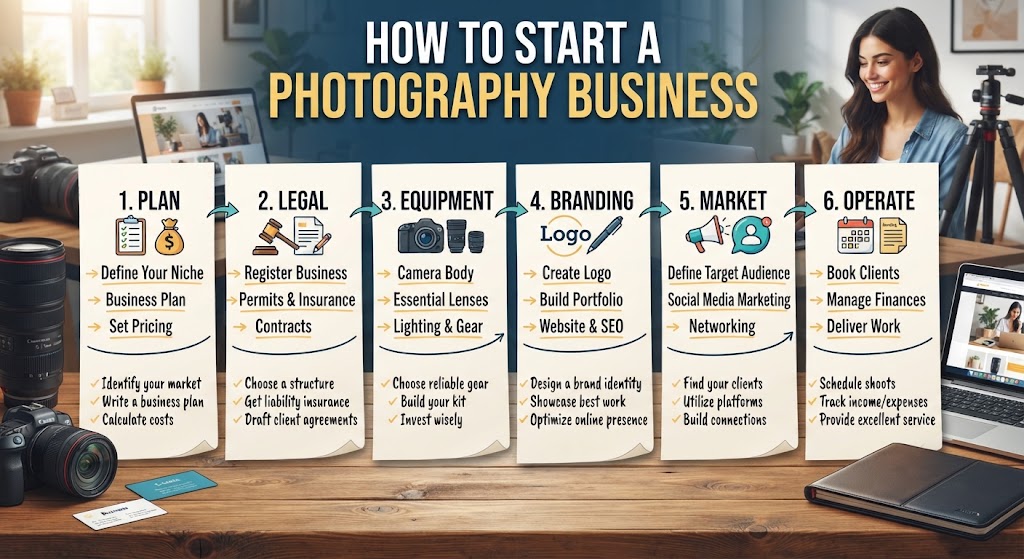
Starting a photography business can turn a creative skill into a sustainable source of income. You do not need a huge studio, a collection of expensive cameras, or years of professional experience to get started. What you do need is a clear niche, reliable equipment, strong business planning, and a way to consistently find clients.
The photography market includes many opportunities, from weddings and portraits to product photography, real estate, events, and commercial work. The right choice depends on your skills, interests, location, and the type of customers you want to serve.
If you are wondering how to start a photography business, the process becomes much easier when you approach it step by step. Here is how to build a professional photography operation from the ground up.
Choose a Photography Niche
One of the first decisions is choosing what type of photography you want to offer. A niche helps you develop a recognizable style and makes your marketing more specific.
Some common photography business niches include:
- Wedding photography for couples and wedding planners
- Portrait photography for individuals, families, and professionals
- Family photography for maternity, newborn, and family sessions
- Real estate photography for agents, brokers, and property owners
- Product photography for online stores and brands
- Event photography for conferences, parties, and corporate events
- Sports photography for teams, athletes, and competitions
- Food photography for restaurants, chefs, and food brands
- Commercial photography for companies and advertising campaigns
You can eventually work across several categories, but starting with a focused service can make it easier to build a portfolio and attract the right customers.
Think about the work you enjoy most and the clients available in your area. A photographer who loves working with people may prefer portraits or weddings, while someone who enjoys controlled studio setups may be better suited to products or commercial photography.
Create a Simple Business Plan
You do not need a 50-page business plan to launch a small photography company. A practical plan should explain what you will sell, who you will serve, what you will charge, and how you will find customers.
Start by answering a few basic questions:
Who is your ideal customer?
Define your target client by age, location, budget, industry, or lifestyle.
What services will you provide?
Decide whether you will offer individual sessions, packages, event coverage, commercial projects, or a combination.
How will you charge?
You might charge per session, per hour, per project, or through predefined packages.
What will it cost to operate?
Consider equipment, software, transportation, insurance, website costs, advertising, editing, taxes, and other business expenses.
How will people find you?
Your options may include search engines, social media, referrals, networking, local partnerships, and online directories.
A basic plan gives you a framework for making decisions instead of buying equipment or setting prices without knowing what the business needs to generate.
Decide on Your Business Structure and Legal Requirements
Before accepting regular clients, research the legal requirements that apply to your location. Business registration, permits, taxes, contracts, and insurance requirements can vary depending on where you operate and what services you provide.
If you are operating in the United States, for example, requirements can differ by state, county, and city. Check official government resources or speak with a qualified business professional before choosing a structure or filing paperwork.
You should also consider a separate business bank account and a system for tracking income and expenses. Keeping business finances organized from the beginning makes bookkeeping and tax preparation much easier.
A written photography contract is equally important. It can establish the scope of work, payment terms, cancellation policy, delivery expectations, usage rights, and other responsibilities.
For commercial projects, pay particular attention to image licensing and usage rights. A client may need different rights depending on whether photographs will be used on a website, in advertising, on packaging, or across other marketing channels.
Buy the Right Photography Equipment
It is easy to overspend on equipment when starting a photography business. A newer or more expensive camera does not automatically create better photographs.
Start with equipment that matches your niche.
A basic setup might include:
- A reliable camera body
- One or two versatile lenses
- Spare batteries
- Memory cards
- A stable tripod when appropriate
- Camera bag
- Portable lighting equipment
- Reflector or diffuser
- External storage
- Computer suitable for photo editing
- Photo editing software
Your lens selection can have a major effect on your style and workflow. A portrait photographer may prioritize a lens designed for flattering subject separation, while a real estate photographer may need a wider field of view.
Do not forget backup equipment for important assignments. Weddings, conferences, and commercial shoots can involve situations where equipment failure is difficult or impossible to recover from.
The goal is not to own every accessory. The goal is to have dependable equipment that allows you to deliver consistent results.
Build a Professional Photography Portfolio
Clients usually want to see your work before they hire you. That makes your portfolio one of the most important marketing assets in your photography business.
If you do not have paid work yet, create your own portfolio through carefully planned practice sessions. You can photograph friends, family members, local products, properties, or styled scenes that represent the type of work you want to sell.
Focus on quality rather than quantity.
A portfolio with 20 strong, relevant photographs can be more effective than a collection of hundreds of unrelated images. Your portfolio should make it immediately clear what you photograph and what a potential customer can expect from you.
For example, if you want to become a wedding photographer, show complete wedding stories rather than filling your portfolio with unrelated landscapes. If your goal is product photography, demonstrate different lighting setups, compositions, backgrounds, and product categories.
Your website should also make it easy for visitors to contact you. Include your service area, portfolio, basic service information, contact form, and a clear call to action.
Set Your Photography Prices
Pricing is one of the most challenging parts of starting a photography business.
Avoid choosing a price simply because another photographer charges that amount. Your costs, experience, location, niche, workload, and business model may be completely different.
Calculate your operating expenses first. Then consider how much time a typical project actually requires.
For example, a two-hour photo session may also involve:
- Client communication
- Travel
- Planning
- Equipment preparation
- Shooting
- Image selection
- Editing
- File delivery
- Accounting and administration
A price that looks reasonable for two hours of shooting may be too low once the complete workload is considered.
You can create several packages to make purchasing easier. A basic package might include a shorter session and fewer final images, while a premium package could include additional shooting time, more images, prints, albums, or other relevant services.
Review your pricing as your experience and demand grow. Your prices should support both the quality of your work and the actual cost of running the business.
Create a Brand and Online Presence
A photography brand does not need to be complicated. Your business name, visual identity, website, portfolio, communication style, and photography style should create a consistent impression.
Choose a professional business name that is easy to remember and spell. Then secure an appropriate domain name and social media profiles where practical.
Your website should focus on the questions potential customers actually have:
What do you photograph?
Where do you work?
What does your photography look like?
How can someone book you?
What should a client expect?
Search engine optimization can help your website appear when people search for photography services in your area. Use relevant service and location phrases naturally in page titles, headings, service descriptions, and image information.
For photographers, visual platforms can also be useful because potential clients can evaluate your work before contacting you. However, social media should support your overall marketing strategy rather than becoming your only source of leads.
Find Your First Photography Clients
Getting the first few clients can be harder than taking good photographs. Start with people and businesses already within your network.
Ask satisfied customers to recommend you to friends, colleagues, or family members. Build relationships with businesses that serve the same audience but do not directly compete with you.
Depending on your niche, potential partners could include:
- Wedding planners
- Event venues
- Real estate agents
- Interior designers
- Local businesses
- Marketing agencies
- Restaurants
- Clothing brands
- Fitness professionals
- Makeup artists
Local networking can be particularly useful for photographers because many assignments depend on location and personal trust.
You can also create location-specific service pages and publish useful content on your website. For example, a photographer specializing in property listings could create helpful content for real estate professionals about preparing a home for a photo shoot.
The objective is not simply to get website visitors. It is to attract people who are likely to become paying clients.
Develop a Reliable Client Workflow
Professionalism does not end when you take the photographs. A smooth client experience can help you earn repeat business and referrals.
Create a standard workflow from inquiry to final delivery.
A simple process might look like this:
Inquiry → Consultation → Quote → Contract → Deposit → Planning → Photo session → Editing → Delivery → Follow-up
Use templates for common emails and documents, but personalize your communication when necessary.
Before each assignment, confirm the date, location, arrival time, requested shots, deliverables, payment status, and any special requirements.
After the shoot, back up the files before beginning your editing workflow. Keep organized folders and use consistent file naming so you can find projects easily.
When delivering photographs, make the process simple for the client. Depending on the project, you may use an online gallery, digital delivery system, or another professional method.
A reliable workflow saves time and creates a better experience for both you and your customers.
Market Your Photography Business Consistently
Marketing should continue even when you have a busy schedule. Otherwise, your pipeline can become unpredictable.
Start with a few channels that match your niche instead of trying to use every marketing platform available.
Local SEO can be particularly valuable for photographers who serve specific geographic areas. Keep your business information accurate and make sure your website clearly identifies your services and service area.
Content marketing can also help. You might publish guides such as:
- What to Wear for a Family Photo Session
- How to Prepare a Home for Real Estate Photography
- Questions to Ask Before Hiring a Wedding Photographer
- How Businesses Can Prepare Products for a Photo Shoot
These topics answer real customer questions while giving search engines more context about your expertise.
If you are building a broader online marketing strategy around your services, resources covering [photography business] can also help you explore different approaches to establishing and growing your photography brand.
Most importantly, track where your inquiries come from. If referrals generate more profitable clients than paid advertising, you can devote more attention to referrals. If local search consistently produces leads, continue improving your website and local presence.
Avoid Common Photography Business Mistakes
Many new photographers focus heavily on photography skills while overlooking the business side. Avoiding a few common mistakes can make the transition to professional work much smoother.
Buying too much equipment too early: Invest in equipment that solves a real business need.
Underpricing services: Consider your complete workload instead of charging only for time spent taking photographs.
Working without a contract: Written agreements help establish expectations and reduce misunderstandings.
Failing to back up files: Losing client photographs can cause serious problems. Maintain a dependable backup process.
Accepting every type of job: A clear niche can make your marketing and portfolio stronger.
Ignoring communication: Fast, clear, professional communication can influence a client’s overall experience.
Relying on one marketing channel: A combination of referrals, search, networking, content, and social platforms can create a more resilient lead pipeline.
Skipping financial tracking: Record revenue and expenses from the beginning so you understand whether the business is actually profitable.
Frequently Asked Questions
How much money do I need to start a photography business?
The amount varies significantly depending on the niche and equipment you already own. A photographer who starts with an existing camera and computer may have lower initial costs than someone building a complete studio from scratch.
Is photography a profitable business?
Photography can be profitable when pricing, expenses, client acquisition, and workload are managed effectively. Profitability depends on factors such as niche, location, experience, demand, operating costs, and business model.
Do I need professional photography qualifications?
Requirements vary by location and type of work. Photography itself may not require a specific qualification in many places, but you should check local business, tax, licensing, and insurance requirements before operating professionally.
How do I get photography clients with no experience?
Start by creating a strong portfolio, working with people in your network, offering carefully planned portfolio sessions, building local relationships, and developing an online presence. Referrals can become especially valuable after you have satisfied your first customers.
What type of photography business is easiest to start?
There is no single option that is easiest for everyone. Portrait, event, product, real estate, and other niches have different equipment, marketing, skill, and client requirements. The best starting point is usually a niche that matches your skills and has identifiable customers you can reach.
Conclusion
Learning how to start a photography business involves much more than purchasing a camera and taking photographs. You need a clear niche, appropriate equipment, realistic pricing, professional contracts, an effective portfolio, and a reliable system for finding and serving clients.
Start small, control your expenses, and focus on delivering excellent work. As your portfolio, reputation, referrals, and business systems improve, you can gradually expand your services and increase your rates.
A successful photography business is built one client and one strong project at a time. With consistent marketing and disciplined business management, your creative skills can become the foundation of a sustainable professional career.