Artificial intelligence (AI) is becoming an important part of how small businesses operate, compete, and serve customers. From automating routine tasks to improving marketing campaigns, AI tools are helping business owners explore new ways to save time and manage daily operations. As these technologies become more accessible, small businesses are moving beyond basic experimentation toward more practical applications.
Recent industry reports suggest that AI adoption among small businesses is continuing to grow. The challenge is no longer simply finding an AI tool. Businesses must also learn how to use it effectively, protect customer information, and measure whether it delivers real value.
In this article, we explore the latest AI adoption news in small businesses, emerging trends, common applications, potential benefits, and the challenges entrepreneurs should understand.
Latest AI Adoption News in Small Businesses
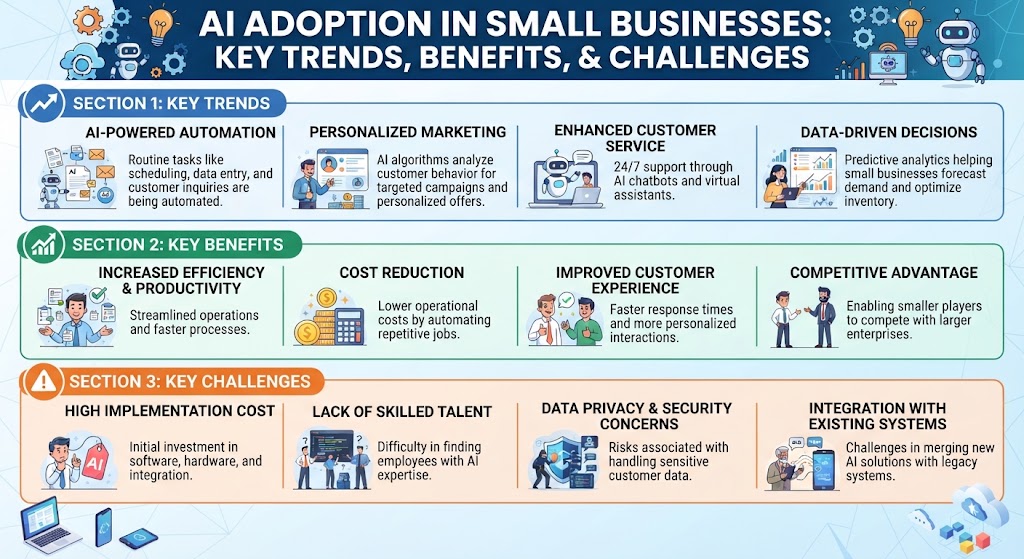
Small businesses are increasingly exploring AI for customer communication, content creation, data analysis, marketing, and workflow automation. Recent reports highlight both the growing interest in these tools and the need for better planning.
According to the U.S. Chamber of Commerce’s 2026 Empowering Small Business Report, 66% of surveyed U.S. small businesses reported using AI, compared with 23% in 2023. The report also found that 47% said AI was creating jobs, while 6% said it was enabling workforce reductions.
These findings suggest that AI’s role in small businesses may extend beyond replacing manual tasks. Companies are also using it to support employees, improve productivity, and explore new services.
However, adoption rates vary depending on the country, industry, company size, and survey methodology. The figures from a U.S. survey should not be interpreted as a global adoption rate.
Another important development is the move toward more advanced AI applications. Businesses are experimenting with tools that can complete multiple steps in a workflow, rather than simply generating text or answering questions.
How Small Businesses Are Using AI in 2026
AI adoption is not limited to large corporations with dedicated technology departments. Many small businesses can begin with readily available tools and introduce more advanced systems as their needs grow.
AI for Marketing and Content Creation
Marketing is one of the most accessible areas for AI adoption. Small businesses can use AI-powered tools to brainstorm blog topics, draft social media posts, create product descriptions, and develop email campaigns.
For example, an online store can use AI to generate initial product descriptions, while a marketing agency can use it to organize content ideas for several clients.
These tools can help teams produce initial drafts faster, but human review remains important. Businesses should check factual accuracy, brand voice, originality, and the quality of the final content before publishing it.
AI-Powered Customer Service
Customer service is another area where AI is gaining attention. Chatbots and virtual assistants can answer common questions, explain product features, and direct customers to relevant resources.
A small e-commerce company might use a chatbot to explain delivery policies or help customers find information about returns. This can reduce repetitive inquiries and allow employees to focus on more complicated customer problems.
Businesses should make it easy for customers to contact a human representative when an automated system cannot provide an appropriate answer.
AI for Data Analysis and Business Planning
Small businesses often collect information about sales, customer behavior, inventory, and marketing performance. AI tools can help summarize this information and identify patterns that deserve further investigation.
For example, a retailer might use an AI-assisted analytics tool to identify products with declining sales or compare performance across different periods.
These insights can support decision-making, but AI-generated forecasts are not guaranteed to be correct. Business owners should verify important conclusions against reliable records and actual market conditions.
AI for Administrative Tasks
Administrative work can consume a significant amount of time in small companies. AI tools may help prepare meeting summaries, organize documents, draft routine emails, and classify incoming requests.
Automating these repetitive activities can give employees more time for customer relationships, product development, and business planning.
Companies should review automated outputs before using them in financial, legal, contractual, or other high-impact decisions.
Major Benefits of AI Adoption for Small Businesses
AI can provide several potential advantages when businesses choose appropriate tools and implement them carefully.
Improved Productivity
AI can help employees complete certain repetitive tasks more quickly. Activities such as drafting documents, summarizing information, and preparing initial marketing materials may require less manual effort.
The actual time saved depends on the task, tool, and level of human review required.
Lower Operational Costs
Some AI applications can reduce the amount of time spent on routine work. For a small business with limited resources, this may help employees handle more tasks without immediately increasing staffing requirements.
However, AI is not automatically cheaper. Subscription fees, setup costs, training, integration, and quality checks should all be included when evaluating its financial value.
Better Customer Experiences
AI-powered customer support and personalization tools can help businesses respond to customer needs more efficiently.
For instance, an online retailer may use automated recommendations to help shoppers discover relevant products. A service company may use AI to categorize inquiries and prioritize urgent requests.
These systems should be monitored to ensure that responses remain accurate, useful, and appropriate.
Support for Business Growth
AI can help small teams handle growing workloads by assisting with research, communication, marketing, and operational planning.
It may also allow entrepreneurs to test new ideas with fewer initial resources. Nevertheless, sustainable growth still depends on product quality, customer demand, sound financial management, and effective business strategy.
Challenges Slowing AI Adoption
Despite its potential, AI adoption creates practical challenges for small businesses.
Limited Skills and Training
Employees may not know how to select appropriate tools, write effective prompts, or evaluate AI-generated results. Without basic training, businesses may receive inconsistent results or rely too heavily on automated outputs.
Small companies can begin with simple training sessions focused on approved tools, common tasks, fact-checking, and data protection.
Privacy and Data Security
AI tools may process information entered by employees, including customer details, internal documents, or financial records. Sharing sensitive information without understanding a service’s data-handling practices can create privacy and security risks.
Businesses should review privacy policies, access controls, and data retention terms before adopting a tool. They should also establish clear rules about which information employees may enter into external AI systems.
Accuracy and Reliability
AI systems can generate incorrect information, misleading summaries, or recommendations that do not fit a particular business situation.
For this reason, AI should support human judgment rather than replace verification. Important facts, calculations, customer communications, and business decisions should be checked before action is taken.
Integration and Ongoing Costs
Some businesses struggle to connect new AI tools with existing software or workflows. Others discover that several subscriptions create more complexity than expected.
Before purchasing a tool, business owners should identify the specific problem it needs to solve and calculate the expected cost of using and maintaining it.
How Small Businesses Can Adopt AI Successfully
A practical adoption strategy does not require a large technology budget. Businesses can start small and expand when they see measurable results.
1. Identify a specific business problem. Choose a repetitive task that consumes time or creates avoidable delays, such as drafting routine emails or organizing customer inquiries.
2. Select a suitable AI tool. Compare features, pricing, privacy protections, ease of use, and compatibility with existing systems.
3. Test the tool on a small scale. Run a pilot project before making it part of a critical business process.
4. Train employees. Explain how to use the tool, how to check its results, and what information must remain confidential.
5. Measure performance. Track useful indicators such as time saved, error rates, customer satisfaction, and total operating costs.
6. Improve gradually. Expand successful applications while reviewing risks and adjusting workflows based on real results.
This approach helps businesses make informed decisions rather than adopting AI simply because it is receiving attention.
The Future of AI Adoption in Small Businesses
AI is likely to remain an important business technology as tools become easier to access and integrate. Small businesses may increasingly explore AI assistants that can support connected tasks, such as organizing customer requests, preparing reports, and coordinating routine workflows.
However, more advanced automation also increases the importance of oversight. Businesses need to understand what their systems can access, what actions they can perform, and when human approval is required.
Training and responsible implementation may become major factors separating businesses that gain meaningful value from AI from those that struggle to use it effectively.
For entrepreneurs, the most useful strategy is to focus on business outcomes. A well-chosen tool that solves a real problem can be more valuable than adopting several technologies without a clear purpose.
Conclusion
AI adoption in small businesses is moving from experimentation toward practical applications in marketing, customer service, administration, and data analysis. Recent U.S. industry findings indicate growing use of AI, while businesses continue to navigate challenges involving cost, training, privacy, and reliability.
Small businesses do not need to automate every process at once. By identifying specific needs, testing suitable tools, training employees, and measuring results, they can explore AI adoption in a controlled and useful way.
The businesses most likely to benefit are those that combine appropriate technology with human expertise, careful planning, and a clear understanding of their customers.
Frequently Asked Questions
What is AI adoption in small businesses?
AI adoption means introducing artificial intelligence tools into business activities such as marketing, customer service, data analysis, content creation, and administrative work.
Why are small businesses adopting AI?
Small businesses are exploring AI to improve productivity, reduce repetitive work, support customer service, analyze information, and help employees manage growing workloads.
What are the most common uses of AI in small businesses?
Common applications include content creation, marketing assistance, customer support chatbots, document summarization, data analysis, and workflow automation.
Is AI expensive for small businesses?
Costs vary. Some tools offer free plans, while advanced services require subscriptions or implementation expenses. Businesses should compare the full cost with the expected benefits before committing.
What are the biggest risks of AI adoption?
Important risks include inaccurate outputs, data privacy issues, cybersecurity vulnerabilities, insufficient employee training, and unexpected implementation costs.
How can a small business start using AI?
Start by choosing one repetitive task, testing a suitable tool, training employees, protecting sensitive information, and measuring the results before expanding its use.
Will AI replace employees in small businesses?
The impact varies by role and business. AI can automate some tasks while helping employees perform others more effectively. Its effect on staffing depends on how each company implements the technology and how its business needs evolve.
SEO Meta Title: AI Adoption News in Small Businesses: 2026 Trends
Meta Description: Explore AI adoption news in small businesses, including 2026 trends, practical applications, benefits, challenges, and strategies for successful implementation.
URL Slug: ai-adoption-news-in-small-businesses
Primary Keyword: AI adoption news in small businesses
Secondary Keywords: AI adoption in small businesses, small business AI trends 2026, AI tools for small businesses, AI business news, artificial intelligence for small businesses, small business automation.
Suggested Tags: AI Adoption, Small Business News, Business Technology, Artificial Intelligence, Business Trends, AI Automation