
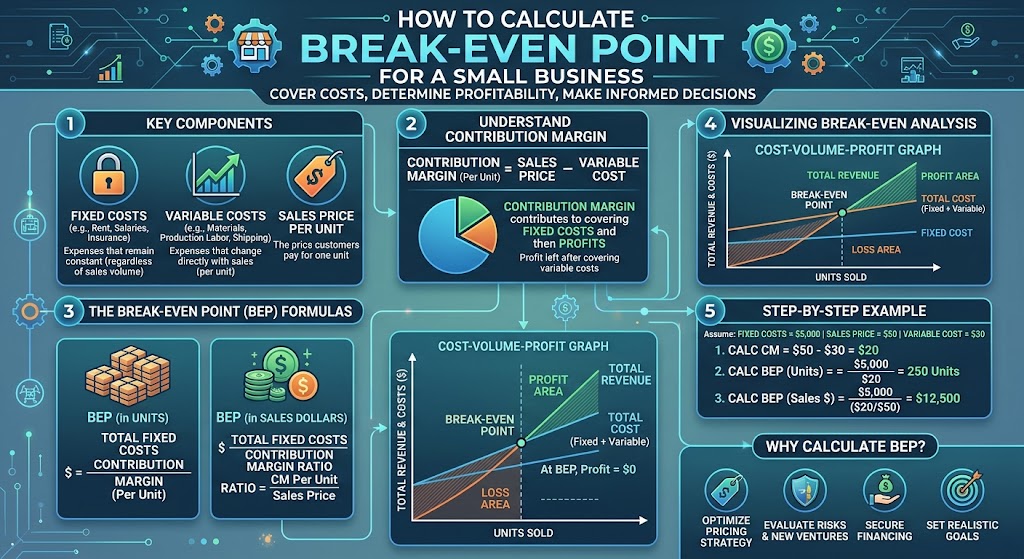
Running a small business requires more than selling products or services. Business owners also need to understand their expenses, revenue, pricing, and profitability. One of the most useful financial calculations is the break-even point, which tells you how much you need to sell before your business starts making a profit.
If you are launching an online store, opening a retail shop, offering freelance services, or running a small manufacturing business, understanding your break-even point can help you make smarter financial decisions. It can also help you set realistic sales targets, choose suitable prices, and avoid spending more than your business can afford.
In this guide, you will learn how to calculate break-even point for a small business, understand the formula, explore practical examples, and discover how to use the result to improve your business finances.
What Is the Break-Even Point?
The break-even point is the level of sales at which your total revenue equals your total costs. At this point, your business is neither making a profit nor experiencing a loss.
For example, imagine you start a small online store selling handmade products. You spend money on materials, packaging, advertising, and website expenses. Your business needs to generate enough revenue to cover these costs before you can begin earning a profit.
If your monthly expenses are $2,000 and your sales revenue is also $2,000, you have reached your break-even point, assuming those expenses include all relevant costs.
However, if your revenue reaches $2,500 while your total costs remain $2,000, your business generates $500 in profit before any additional expenses or taxes not included in the calculation.
Understanding this point helps you answer an important question: How much do I need to sell to cover my business expenses?
Why Is Break-Even Analysis Important for Small Businesses?
Break-even analysis gives business owners a clearer picture of their financial position. Instead of guessing how many products they need to sell, they can use actual costs and prices to establish a measurable target.
Here are several reasons why this calculation matters.
1. It Helps You Set Realistic Sales Targets
A sales target becomes more useful when you know how many units you must sell to cover your expenses. You can set daily, weekly, or monthly targets based on your break-even point.
2. It Helps You Set the Right Prices
If your selling price is too low, you may need to sell a large number of products just to cover your expenses. Break-even analysis helps you evaluate whether your current price is financially sustainable.
3. It Supports Better Budgeting
Knowing your fixed and variable costs helps you estimate how much money your business needs to operate each month.
4. It Helps You Evaluate Business Ideas
Before investing in new equipment, launching a product, or opening a second location, you can estimate how much additional revenue you will need to cover the extra costs.
5. It Improves Financial Planning
Break-even analysis can help you prepare for slower sales periods, evaluate discounts, and understand how changes in expenses affect your business.
Understanding the Main Costs of a Small Business
Before calculating the break-even point, you need to understand the different types of business costs. The calculation depends on separating fixed costs from variable costs.
Fixed Costs
Fixed costs are expenses that generally remain the same within a particular period and operating range, regardless of how many units you sell.
Examples include:
- Monthly office or shop rent
- Business insurance
- Website hosting subscriptions
- Fixed software subscription fees
- Salaries for permanent staff, where they do not vary with sales
- Equipment lease payments
Suppose your business pays $800 in rent, $100 for software, and $100 for insurance each month. Your total monthly fixed costs would be $1,000.
Fixed costs can change over time, but they usually do not increase with every additional unit sold.
Variable Costs
Variable costs change according to the number of products or services you sell or produce.
Examples include:
- Raw materials
- Product packaging
- Per-unit manufacturing expenses
- Sales commissions
- Payment processing fees that vary with transactions
- Shipping expenses paid for each order
For example, if each product costs $8 to manufacture and package, your variable cost is $8 per unit, before any other per-sale expenses.
Selling 100 units would create $800 in variable costs. Selling 200 units would create $1,600 in variable costs, assuming the cost per unit remains unchanged.
Semi-Variable Costs
Some expenses include both fixed and variable elements. These are often called semi-variable or mixed costs.
For example, a business internet plan may include a fixed monthly fee plus additional usage charges. Electricity bills may also contain a fixed service charge and usage-based costs.
For a basic break-even calculation, you can separate these elements where practical. This makes your estimate more accurate.
The Break-Even Point Formula
The formula depends on whether you want to calculate the number of units you need to sell or the total sales revenue required to cover your costs.
Revenue
The difference between the selling price and the variable cost per unit is called the contribution margin per unit.
For example, if you sell a product for $50 and its variable cost is $30, the contribution margin is $20. Each unit contributes $20 toward paying fixed costs and, after fixed costs are covered, generating profit.
The break-even formula can therefore be simplified to:
\[ \text{Break-Even Units} = \frac{\text{Fixed Costs}}{\text{Contribution Margin per Unit}} \]
What Is the Contribution Margin Ratio?
The contribution margin ratio shows the portion of sales revenue remaining after variable costs.
\[ \text{Contribution Margin Ratio} = \frac{\text{Selling Price} – \text{Variable Cost}} {\text{Selling Price}} \]
Multiply the result by 100 to express it as a percentage.
If a product sells for $50 and has a variable cost of $30, the contribution margin is $20, and the contribution margin ratio is 40%.
This ratio is useful when you want to calculate the break-even point in sales dollars rather than product units.
Step-by-Step Example: Calculate Your Break-Even Point
Let’s use a realistic example to understand how the calculation works.
Imagine you own a small business that sells reusable water bottles. You want to determine how many bottles you need to sell each month to cover your operating expenses.
Your estimated monthly costs and selling price are:
| Business detail | Amount |
|---|---|
| Monthly fixed costs | $1,500 |
| Selling price per bottle | $25 |
| Variable cost per bottle | $10 |
| Contribution margin per bottle | $15 |
Now, calculate the number of bottles you need to sell.
Step 1: Calculate the contribution margin.
Subtract the variable cost from the selling price.
$25 − $10 = $15
Each bottle contributes $15 toward your fixed costs and, eventually, your profit.
Step 2: Divide fixed costs by the contribution margin.
$1,500 ÷ $15 = 100 bottles
Your business needs to sell 100 bottles per month to break even, assuming the costs and prices remain unchanged.
Step 3: Check the result.
At 100 bottles, your total revenue is $2,500. Your variable costs are $1,000, and your fixed costs are $1,500.
| Financial calculation | Amount |
|---|---|
| Total sales revenue | $2,500 |
| Total variable costs | −$1,000 |
| Fixed costs | −$1,500 |
| Profit or loss | $0 |
The result confirms that your business covers its estimated costs at 100 bottles.
If you sell more than 100 bottles, each additional bottle contributes $15 toward profit, provided the same cost and pricing assumptions still apply.
How to Calculate Break-Even Sales Revenue
Sometimes you need to know the dollar amount of sales required to break even rather than the number of units.
This is particularly useful for businesses that sell products at different quantities or monitor their finances using monthly revenue targets.
The formula is:
\[ \text{Break-Even Sales Revenue} = \frac{\text{Fixed Costs}}{\text{Contribution Margin Ratio}} \]
Using our water bottle example:
- Fixed costs: $1,500
- Selling price: $25
- Variable cost: $10
- Contribution margin ratio: 60%
The calculation is:
$1,500 ÷ 0.60 = $2,500
Your business must generate $2,500 in monthly sales revenue to break even.
This figure matches the revenue from selling 100 bottles at $25 each.
For a business selling multiple products, you can use a weighted-average contribution margin ratio based on your expected sales mix. Remember that your break-even result may change if customers begin purchasing different products in different proportions.
How to Calculate Break-Even Point for a Service Business
Break-even analysis also works for businesses that sell services instead of physical products.
Consider a freelance graphic designer who provides branding packages to small businesses. The designer has monthly fixed expenses of $900 for software, internet, marketing subscriptions, and other overhead costs.
Each branding package sells for $300. Direct costs, including outsourced work and transaction fees, average $60 per package.
The contribution margin per package is:
$300 − $60 = $240
The break-even calculation is:
$900 ÷ $240 = 3.75 packages
Since the designer cannot sell three-quarters of a complete package, they need to sell four packages per month to cover these estimated costs.
At four packages, revenue is $1,200, direct costs are $240, and fixed costs are $900. The resulting profit is $60 before any additional costs or taxes not included in the example.
This method can help freelancers, consultants, marketing agencies, cleaning services, and other service providers establish monthly client targets.
What Happens When Your Costs or Selling Price Change?
Your break-even point is not permanent. It changes whenever your fixed costs, variable costs, selling prices, or product mix changes.
Understanding these effects can help you make better decisions.
When Fixed Costs Increase
Suppose your monthly rent increases from $1,500 to $1,800. If your contribution margin remains $15 per bottle, your new break-even point becomes 120 bottles.
You must sell 20 additional bottles each month just to cover the higher fixed costs.
When Variable Costs Increase
Imagine the supplier raises the cost of each bottle from $10 to $13. Your contribution margin falls from $15 to $12.
With fixed costs of $1,500, you now need to sell 125 bottles to break even.
This illustrates why supplier negotiations, waste reduction, and inventory management can make a meaningful difference to profitability.
When You Increase Your Selling Price
Suppose you increase the selling price from $25 to $28 while keeping variable costs at $10.
Your contribution margin rises to $18. With fixed costs of $1,500, the break-even point becomes approximately 84 bottles when rounded up to a whole unit.
However, higher prices may reduce demand. Before increasing prices, consider competitors, customer expectations, product quality, and how sensitive your customers are to price changes.
When You Offer Discounts
Discounts can attract customers, but they also reduce your contribution margin.
For example, if you lower your $25 selling price to $22 while the variable cost stays at $10, your contribution margin falls to $12. You would need to sell 125 bottles to cover $1,500 in fixed costs.
Before offering a discount, calculate whether the expected increase in sales volume will compensate for the lower margin.
Common Break-Even Calculation Mistakes
A break-even calculation is only as reliable as the numbers you use. Small business owners can make several common mistakes when estimating their costs and revenue.
Ignoring hidden expenses: Shipping supplies, payment fees, returns, advertising, maintenance, and other expenses may be overlooked. Include relevant costs so your estimate reflects the actual business model.
Mixing fixed and variable costs: Rent is usually fixed within the relevant period, while product materials generally vary with production. Classifying costs incorrectly can produce misleading results.
Using an unrealistic sales price: Your listed price may not be the price customers actually pay after discounts, refunds, and promotions.
Forgetting the owner’s compensation: If you want to calculate the sales required to support your personal income, include an appropriate owner compensation target as an additional cost. Otherwise, your business might break even financially without providing enough income for you.
Assuming sales will remain constant: Demand, supplier prices, wages, and operating expenses can change. Review your estimates regularly instead of relying on a single calculation indefinitely.
Confusing break-even with a profit goal: Breaking even means covering the costs included in the calculation. It does not automatically mean you have earned your desired profit or covered every tax obligation.
How to Use Break-Even Analysis to Grow Your Business
Calculating your break-even point is only the first step. The real value comes from using the result to improve business decisions.
Here are five practical ways to apply it.
1. Set a Monthly Sales Target
Start with your break-even point and decide how much profit you want to earn above it. Divide the required sales volume into weekly or daily targets based on your operating schedule.
For example, if you need to sell 100 products per month, you can use that number to plan your marketing activities and monitor your progress.
2. Prepare a Cash Flow Budget
Profitability and cash flow are not the same thing. A business might generate enough sales on paper but still struggle to pay bills if customers delay their payments.
Compare your expected income with the dates when rent, supplier invoices, wages, and other bills are due. This helps you plan for short-term cash shortages.
3. Review Your Costs Regularly
Check supplier prices, subscriptions, rent, and marketing expenses each month. If costs rise, recalculate your break-even point before setting a new sales target.
4. Evaluate New Investments
Before buying equipment or hiring additional staff, estimate how much your fixed costs will increase. Then determine how many additional sales you need to cover the investment.
5. Track Your Actual Performance
Compare your estimated break-even point with your real sales and expenses. If your business consistently falls short of its target, investigate whether the problem is low demand, high costs, weak pricing, or ineffective marketing.
Frequently Asked Questions
What is a good break-even point for a small business?
There is no single ideal break-even point for every business. A good target is one that your business can realistically achieve while leaving enough room for profit, unexpected expenses, and fluctuations in demand.
Can I calculate my break-even point in Excel?
Yes. Excel is useful for calculating break-even units and revenue. You can enter fixed costs, selling price, and variable cost in separate cells, then use formulas to calculate the required sales volume.
For example, if cell B1 contains fixed costs, B2 contains the selling price, and B3 contains variable cost per unit, use:
=B1/(B2-B3)
Make sure the selling price is greater than the variable cost. Otherwise, the business cannot cover its fixed costs through additional unit sales under those assumptions.
What is the difference between break-even point and profit?
The break-even point occurs when total revenue equals total costs, resulting in zero profit or loss under the calculation’s assumptions. Profit occurs when revenue exceeds the relevant costs.
How often should I calculate my break-even point?
Review it monthly for a small business, or whenever you make a significant change to pricing, supplier costs, rent, staffing, or other operating expenses.
Can a business have more than one break-even point?
Yes. A business with multiple products, changing prices, different operating capacities, or more complex cost structures may have different break-even scenarios. A multi-product business usually needs to consider its expected sales mix when calculating an overall break-even point.
Does break-even analysis guarantee business success?
No. It is a planning tool, not a guarantee. It helps you understand the relationship between costs, prices, and sales, but it does not guarantee customer demand, sufficient cash flow, or long-term profitability.
Conclusion
Learning how to calculate the break-even point for a small business helps you understand the minimum sales required to cover your operating costs. By identifying fixed expenses, calculating variable costs, and determining your contribution margin, you can establish realistic sales targets and make more informed pricing decisions.